just did one more test on the perlin noise - a poor man version of ocean shader. well, not realities at all but it is cheap only using 1 drawing call and everything running inside the shader 
[ webplayer ]
http://homepage.mac.com/antonioh/unity3d/build/Perlin_Ocean.html
[ sample video ]
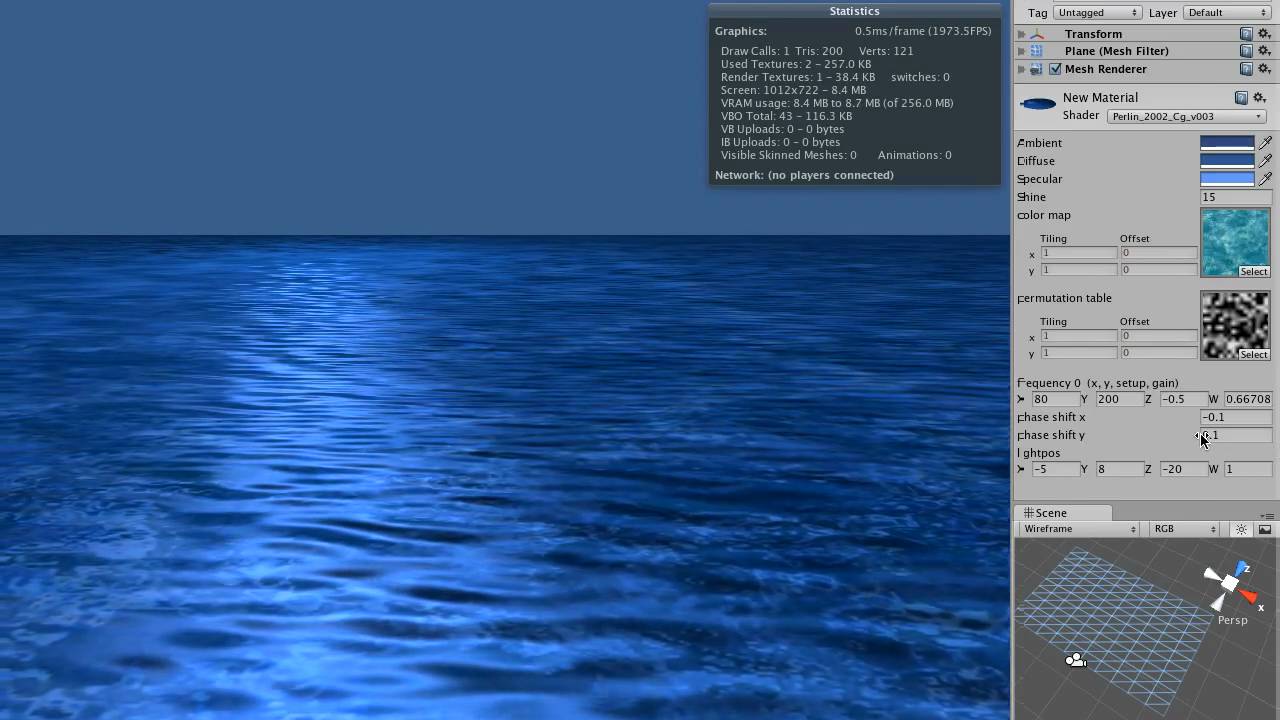
Basically, it is a very simple shader. Its use 2 channel of 2D Perlin noise to generate the normal.
float4 fragment_shader( v2f IN, out float4 finalcolor): COLOR
{
	float2 ph 	= float2(shift_x, shift_y);	// Phase Shift
	float2 time = float2(_SinTime.w, _CosTime.w);

	ph 			+= time /3.0;
	freq_0.xy 	+= time /5.0;

	float n0 	= noise(IN.texcoord*freq_0.xy	 )*freq_0.w;
	float n1 	= noise(IN.texcoord*freq_0.xy +ph)*freq_0.w;

	float nx = n0-n1;
	float ny = n0-n1;

	float nz = sqrt(max(0, 1-(nx*nx+ny*ny*freq_0.z)));
	float3 normal = normalize(float3(nx, ny, nz ));

	float4 c = tex2D(color_map,IN.texcoord*8.0 +ph*0.1)*nz;

	float3 L 	= normalize(IN.light);
	float3 V 	= normalize(IN.eye);
	float diff 	= saturate(dot(L,normal));
	float spec 	= saturate(dot(normalize(L-V),normal));
	float att 	= 1.0 - max(0,L.z);
	att = 1.0 - att*att;

	return c*ambient_color + att*(c*diffuse_color*diff+specular_color*pow(spec,shine));
}
I also, put in some code to animate the vertex too 
	float4 pos = float4(IN.vertex.xyz, 1.0);
	float3 d = 0.25- min(0.25, distance(_ObjectSpaceCameraPos, pos.xyz) *0.025);
	pos.y = cos(pos.x *_SinTime.x + pos.z *_CosTime.x) *d;
Enjoy !