Solving a BIG problem (GRAPHICS) ... if it is actually a common problem

At this point nothing specific. I always list out most things needed in the game. At the least in my head which works fine for the tiny games I have been making. I don’t detail everything because I found that doesn’t work out so well. Many years ago I used to list everything and try to design the games completely defining it all on paper from assets to code and so forth. I found it was just way too rigid and during development things change and you have to be able to change based on what you find out after you start implementing.

That being said I do kind of like the idea of making a game featuring a barbarian and a good amount of melee combat. And I have certain things I would like to be in it such as the sunrise, day, sunset and night periods as the story unfolds. I think something with some actual combat would be cool… like not just hit, hit, hit the enemies and they are dead but more like actual back and forth battles. Not to the degree of something like Mortal Kombat but somewhere in-between that and the typical platformish game. I like the idea of there being different modes of gameplay. Even if they are just mini games like fishing for food, etc. Maybe in a boat and that level is entirely about the player crossing a body of water to the land on the other side where his journey can continue. I’d like for the game to provide a good amount of interaction… more than is normal anyway.

As you can see there is no actual game defined yet; instead just a bunch of loose concepts that I feel would be interesting to be in it. That’s mainly because I’ve been focused on solving this graphics issue once and for all. And I think dropping down to 128x72 will finally be the answer.

Anyway, when I get to the graphics solution I will probably take a break again from game dev. And then when I get back to it again I will start thinking about the actual game. Then I will define things in more concrete terms. First, will be the story. I always start my game designs with a story. Normally very simplistic but that’s enough to shape the game design.

Basically when I make games I try to make a story the player can experience whether they are really thinking about the story or not while playing it. And ultimately for a bigger game like I would like my next one to be the ideal is for the player to be sort of writing a story in their head that is more or less the story I used when designing the game. But of course for each person it will be a little different.

I don’t want to just tell them a story. I want the player to experience a story in their own way. Like if they tell a friend about it I imagine it being something like this “I started out in this forest area where I [whatever they did there] and then went into a huge freaking cavern and found [whatever it was] and then I found an underground river and a boat. So I took the boat down the river and came out the opening and I think I was maybe in the ocean or something. Anyway then I had to…”

Basically the gameplay experience & progression is writing a story. I will sort out the story and that will drive the game design and that will drive the requirements. But it will be a while before I start on any of that. I’m really still in half-burnout mode on this game dev stuff.

yup,

when i said to put down an asset list, it’s meant to be crude and change over time but at least there is a starting point.

With resolution, I would think of the target resolution and possibly of ease of further detailing if you end up working with an artist (i.e. develop at a higher resolution but just paint in say 8x8 pixel blocks for now).

Do you have a reference game from the gameplay / style perspective (disregarding art, etc.). Could be a modern heart of africa (fighting, exploring, digging, trading)…I could see this actually working well in low res like the original but with modern mechanics.

ps: I even put this down now on my own game idea list :slight_smile:

I have no game reference. I’m sure I could find several different game references and say like this bit from this game and that bit from that game and this other hit from this other game. But it is mainly these ideas I have had in my head for a long time. And in many ways it is just an experiment. Kind of a “I wonder what a game like this that had these things would be like to play?”

I don’t expect I’ll do it on my next game either. To do everything at the detail level I’d like to do it will take a lot of time. So like usual I will take the path of iteration to get there. This next game will hopefully have at least a tiny bit of each of the things I want in a “dream game” or it will have large chunks of only one or two of the things. I won’t even know which way to go until I start and know what I feel like tackling at that time.

I am just taking it slow & easy. Sure when I do game dev I usually race like a mad man but I don’t have that drive & passion any more. At least not at the moment. Even just talking about this stuff is almost tiring to me. Definitely a case of burnout going on here. lol

I probably should take a break from here and other forums again.

Firstly I guess, a caveat, I’m not talking about simple stuff like vector objects/backgrounds. I’m pretty comfortable creating simple vector and pixel art. i.e. assets for a slingshot game (slingshot, ice, wood and broken wood):

2911364--214680--Slingshot.png 2911364--214679--IceBlockShort.png 2911364--214681--PlankShort.png

The issue is mainly characters, and animating said characters. I can generally get a static pose, although there’s only about a 30% chance I’ll be happy with it after say an hours work. A few hours later I might get a walk cycle but the odds probably go down to about 20%. Once you get to jumping, attacking, etc it goes out the window. I could easily spend 2-3 days trying to get the basic idle, jump, walk, attack for a simple character.

For a complex character I will utterly fail: maybe 10% chance I’ll get a basic idle pose that I like, and about zero percent chance it goes beyond that.

I could probably do the kind skeletal stuff (I do own spine), but theres two issues I have with that:

  1. I generally don’t like that style very much
  2. I have people who will do that sort of stuff for me in exchange for time spent on code, so it s a lot harder to motivate myself to do the initial learnings
1 Like

@GarBenjamin if you are considering paying for poser have a look at Daz3D that is often on promotion and when it is, it is free. If you are more interested in 2D then look at Reallusion and the CrazyTalk animator, this comes with a variety of motion actions and the Reallusion store has a lot more. All the Reallusion stuff was created to speed up cutscenes and animation for AA companies, although it is used for other reasons, so it has a good workflow setup. I use that stuff myself as well as iClone, although I’ve switched over to Creature in the hopes that I can reduce the cost of getting animations made.

It has correct proportions and fully rigged skin. Basically, a fully-prepared posing doll. You can use it as a reference, a base for actual character, or manikin for modeling armor pieces, if your character is something like a walking suit of armor.

In case of Blender, a good idea would be to use mhx2 importer (which used to be part of makkehuman till developers got full of themselves).

Unity also has this:
https://www.assetstore.unity3d.com/en/#!/content/45808
https://www.assetstore.unity3d.com/en/#!/content/45810

Though I never used those.

You can, but mecanim is not perfect - far from it. Slightly unusual posture can easily result in broken neck, awkwardly turned shoulders, twisted limbs, etc. If your character uses props (like weapons) and those are animated, you can pretty much forget about retargeting them - the process will fail to produce anything useful.

Even in 2d, you might want to think of a rock being a 3-dimensional object. Even if it uses two or three colors, it can still be decomposed into base shapes/primitives, there will be a light source somewhere, surfaces facing the light will be brighter, and those facing away from it will be darker.

A good approach could be first to sketch the edges and then paint over the shading.

In the second example there’s area (lower left corner) which looks a bit strange, because “lit” shapes interlock in an unusual fashion.

Is any of that really considered “typical programmer skillset”? I’d rather see them as gamedesign skills. I’m under the impression there are great programmers who make terrible choices for gamefeel and controls, and there are programming noobs who have a much better grasp of these aspects because they play more games and have better adopted the gamedesigner mindset.

I’ve tried pyxel edit for the first time yesterday. My first impression was “this is terrible”, but after I gave it a second chance and took a closer look at the tile-based workflow I gotta say it has something going for it. You paint on 1 picture, but you can define tiles and paint with these tiles. So a cell on the grid stores the information which tile it belongs to, and when you paint there it automatically updates all grid cells that use the same tile. So you have a live preview of tiling patterns etc… Afaik you can even flip or rotate tiles nondestructively and keep the live preview. I could see how that might help you speed things up if a tilebased workflow fits your game.
I haven’t tried its single-sprite animation features yet, but it’s fairly certain I’ll still prefer aseprite for that. It has a clever way to display frames and layers as a matrix where you can link cells. So if 1 part stays the same for x connected frames, you don’t need to copy your changes over to the frames, you can just link the cels and make it one layer that lasts for x frames.

I think a much better idea would be to try everything in order to discover what “your strengths” really are. Who knows, maybe you have a knack for a completely different field. If you just stick to the strengths you already know, then you might not ever discover the other skills you can get good at.

1 Like

That definitely clarifies it. Your vector art looks very good to me. Although for some reason I just never liked vector art that much in games. Don’t ask me why because I don’t really know. I suppose it is the same as some people don’t like pixel art. Maybe it just looks too smooth / too cartoony (not yours specifically but vector art in general I mean).

I completely get what you’re saying about characters and animating them. See though it’s like you said “there’s only about a 30% chance I’ll be happy with it after say an hours work”. And that is just too much time to spend on any one thing especially something as tiny as one frame for one character sprite.

With that speed how can you make anything within a reasonable period of time except a game where the focus is basically all about the graphics? Either (1) spend many years (with much of it devoted solely to the art), (2) simply have nothing much to the game itself or (3) reuse the graphics heavily relying on recoloring them to add some variety and signify different types of the object.

#1 and #2 are not acceptable in my opinion. #3 I think is a smart shortcut. It makes sense to do that.

So there needs to be a solution for this. And for me that solution is simply accepting that my games will never look like this (from a raw art quality perspective):

https://www.youtube.com/watch?v=pSv6HABKnl8

Nor will they look like this:

https://www.youtube.com/watch?v=CoMdZ_87oWA

Okay, so it is important to set expectations realistically.

And this probably applies to you and other programmer-oriented folks as well.

So now we know what the games we make will not look like it’s time to look at what the games we make can look like.

Our games can certainly look as good as this and it would take a very small amount of time to make these graphics allowing us to focus on the gameplay experience and make a huge even epic game:

https://www.youtube.com/watch?v=fSiCyR9KjJ0

And our games can look like this. Again still not a major amount of time required for the graphics and animation yet enough that it would possibly double or triple the amount of time from the previous target:

https://www.youtube.com/watch?v=8_nIWaQZDBM

Finally, it is possible that we could make our games look like this. However, this would now have us doubling maybe tripling the amount of time we spend on graphics from the previous target and 4x to 9x the amount of time needed for the Super Amazing Wagon Adventure target:

https://www.youtube.com/watch?v=5kCzNZJa_ZU

Another option is to simply make different types of games completely where we can rely on simple shapes and our programming skill to make the display more interesting.

This is where I am at. Realistic expectations. Realistic goals. I think Kero Blaster represents the most amount of time I could spend on graphics but possibly one day maybe something similar to Curses 'N Chaos. But that would need to be a simpler game much like that game is or like the games I have made previously. And of course, it would have greatly increased the development time of my previous games had I done that. Instead of a few weeks they probably would have taken a few months. Which is not reasonable to me.

Well I slept most of the day then visited the forum here. So I have done absolutely nothing. But I do feel recharged and not nearly as burnt out as I was last night.

I think I will get some food then drop the resolution down and see how long it takes to animate the barbarian dude walking.

BTW I don’t know if these are helpful to any of the programmers but I find references very handy.

This has the so called 25 Best Walk Cycle Animation Videos

All kinds of motion videos of people and animals here

Various random videos for animation reference here

You can get a library of reference clips here

I won’t use any reference for the barbarian walking just because I have done character walking numerous times and if needed I just make a little 2-finger man walking across the keyboard for a quick & easy reference. I like things simple, quick & easy. :slight_smile:

Alright food time then animate time.

I would be very interested in hearing from any artists or programmers who routinely knock out game graphics very quickly. If that’s you please feel free to post examples, specify how much time the graphics took (mainly interested in 2D character animations) and the method you used to achieve the speed.

It’s kindof funny that you’re mentioning Automation, fancy programs/scripts, creating large sets, etc.

I spent a lot of time doing exactly that in my earliest days as a budding gamedev.

My first project was to be an MMORPG with 40 playable character races, in the same art style as Ultima Online (2D Isometric, Paperdolls, etc.)

In fact, it is the literal catalyst that launched me into gamedev, when my sister linked me to DAZ3D, 3DRT, Arteria3D, and I saw an entire world open up right in front of my eyes: “I…I could be a game developer!!”

To make a long story short, I had absolutely no artistic talent whatsoever, but needed very particular art, 3D models, textures, animations, etc.
I researched if this was possible. Despite what everyone told me (It was impossible, I was an idiot, and it was nuts) I did it anyway.
With an extensive catalogue of DAZ3D models, I recreated quite an elaborate & amazing “Paperdoll” system.

DAZ3D has a pretty amazing catalogue. Not just 3D models, but automated scripts & programs to adapt things to different models.

See how the Genesis model can morph, fitting the clothes?

Skip to 1:44

https://www.youtube.com/watch?v=cTBBnc2SJ90

Now, I did all of this years before Genesis, but WITH Genesis I was able to do even more with my art.

By the end of my created system…Within a few hours, I could create an entire character, render endless numbers of clothing & equipment. All at the cost of about $5 per character. Fully animated. Fully clothed & equipped with every item in the game. All automated, imported, rendered, etc.

Very little effort on my part.

(Bad resolution for some reason; but these were all rendered at extremely high definition), then shrunk to preserve detail.)
5704018--596614--Paperdolls1.gif

Now, these were all animated of course. So you had tens of thousands of sprites layered on top of each other. Which meant I had created my own scripts to rename the files, import them, & all around automate the process to make it incredibly simple to render a single sprite layer but have it animate flawlessly.

And here is the first draft in Unity; a lot more polished.

5704006--596605--PaperDollsWalk2.gif

I had this for all creatures too.

5704018--596611--DragonHead (1).gif

5704006--596599--DragonWalk1 (1).gif
^GifCamera using Windows Photo Viewer + Arrow Keys, hehe.

Here is a prototype of the game, when I was testing as to whether or not to allow players to build things similar to Minecraft (I was able to automate all of that art too, in a very acceptable way)

2912139--214736--Decided Against Minecraft.png

I had a literal endless catalogue. Characters, Environments, Themes, etc. All rendered in x8 directions. Any creatures I needed that were not present in DAZ3D, I could get commissioned to be made (compatible with DAZ3D). Even potentially reselling the assets on DAZ3D to make up for the cost. A very interesting way to self-fund.

I was able to preserve some amazing details too, even when things were shrunken. (I compared details & clarity of polygons/textures whenever I was getting into downsampling the art.)

In the end, my biggest problem was RAM, V-RAM, and load times. Mainly due to the size of characters like the Dragon, who could take up 4096x4096 to 8192x8192 of texture memory per frame, in all 8 directions, with hundreds of frames loaded every second. However, this was all entirely feasible. Even more so now with what was high-end hardware now being pretty standard. Performance was pretty awesome too.

Wish I could show a lot more GIF’s & Images, but Unity limits to 5 & I don’t want to do more than 1 post.

3 Likes

That’s quite an elaborate system. I can see where in the end it would save you a lot of time and I maybe I am misunderstanding something but it seems like this route would require an extensive amount of time up front just focusing on creating the graphics library and system.

I’ve thought about similar things in the past from making characters out of separate parts (much like SmoothMoves, Spriter [I think], etc does) and overlaying clothes, weapons and so forth… but again this all seems like it just adding even more time and work to the art creation process so I never did anything with it beyond the barest bones of tests.

It still is an interesting method that may well be one of the best tools in a programmer’s toolbox to take the time to create such a library and system. Thanks for sharing!

1 Like

I honestly don’t know how long it would take to build such a system.

I had to learn everything about 3D art, meshes, texturing, animations, gamedev art, game programming- the works, just to be able to do all of this. With all that learning, it was 2 years before I was ready. However, I did a lot of messing around with a lot of different things, so I’m not exactly sure what all of those 2 years include.

The actual system, if I were to do it all again having all that experience? It would probably take be very little time to set up, since I already know all of the programs to use & the entire process from start to finish. Having to create that system myself without knowing how though? I have absolutely no idea.

I had to do some pretty complex stuff, which in all actuality (since I had 0 skills in art & programming at the time) I ended up having to find very specific programs or plugins to do exactly what I needed. Fortunately it was all there.

Also I’d like to mention other programs that can create some wonderful art for games, with absolutely no artistic talent required.

I used Campaign Cartographer to create world map art, which ended up becoming one of my game’s major features- and in all actuality could have been the entire game.

Prototyped Game World
2912151--214749--RegionssQUARED.jpg

My actual gameplay map (5 squares of the above map)
2912151--214748--CompleteMapSmall.jpg

My city level, using the type of art I obtained the rights (permission) to use
(someone else’s image map, but of something I myself could make since I owned the rights to the exact same artwork & program.)
1870403--120183--citymapexample.jpg

I use ‘another example’ of a completely different art program, to show how accessible user-created game art can be. There are many programs where you can purchase art packages for dirt cheap, that are used to create your own custom game art. Even better, a lot of these companies are absolutely fine with giving permission to use their program’s artwork in your own game, or as is the case of places like DAZ3D, it is entitled to you on purchase as you own all your renderings.

Also because most gamedevs don’t even fathom any of these art programs / assets can be used in games. Most instantly assume “Nah, it’s not possible.” Hell, I was told I was a total liar when I claimed that I was able to create art for 40+ Races, 40+ animations, and 100’s of items/environments for a few thousand dollars & a few hours of work in a system I had created. And the more I worked on the system, the better the render quality was (realistic skin, better looking features, etc.)

All of this was done because I had no artistic talent whatsoever, but I wanted to make games. And I liked the idea of something better than ASCII Art.

This is what happens when I get desperate, crunched with time & money restrictions. I innovate. :stuck_out_tongue:

1 Like

I dropped the resolution down to 128x72 and it still takes far too long just to animate a walk cycle. And I think again the whole issue is due to trying to make it look good. This causes continual refinement and testing.

Since I don’t think I can completely remove the focus on quality from my mind I think the only way forward is to either drop the resolution down even further or change the character style to not even attempt to make it like a proper human at all.

See, I think this kind of thinking may be the way to go. It also is something many Indies have done and I am thinking it is quite likely they chose this route for the exact same reason. It just taking way too damn long to create & animate “proper” humanoid characters. So instead they ended up with stuff like this:

In fact, I’ve noticed that many Indie 2D games the characters seem to not even have legs. They have either just feet or like what could best be described as two sticks with each stick leg alternating up and down to represent movement.

And where some people may think all of these games are doing this as a stylistic choice I don’t believe it. I think it is very likely these games ended up this way to greatly simplify the amount of time required to animate the characters and create the graphics in general.

So, this may be something worth exploring. I’ve never tried to intentionally draw a malformed character before with quarter normal size stick legs. But I can see that it would greatly speed up animation process.

Of course, another thing is… like I mentioned above… maybe I am just too damn focused on trying to making stuff look good. Maybe I just need to literally knock out the animations and how they end up is how they end up. I’d not considered that before now and it could well be the case. Perhaps I am trying too hard to make things look good while also trying to do things very quickly.

Hmm… alright I will have another go at 128x72 barbarian animation this time literally not giving a damn how it looks and only focusing on animating the character. With some luck this will be the key! Because I gotta say I am about to the point of saying to hell with this stuff. lol

1 Like

SO TRUE :stuck_out_tongue:

This is a known solution, for a long time, but as seen in this thread, some will fight nail and all to say it’s not possible lol.
Also upfront cost is necessary as the time save is actually exponential, while pure 2d is linear. And they end up spending more time not doing the little work that save time.

http://lostgarden.com/uploaded_images/ProceduralVsHandCrafted-727929.jpg

1 Like

I show off this system to say this: An automated system is entirely possible. Really cheap, customizable, awesome art. Not just with how I did it, but through more avenues I’m sure. Simpler ones, definitely.

Procedurally Generated Graphics are an extremely interesting subject to me as well.

I was able to include many features of modern 3D Animation. The same type of art features that Pixar/DreamWorks use.
Here’s a few things I did with this type of art:

Performance-Less Cloth Simulation (No 3D calculations or CPU usage required)

2912163--214751--JessCloth.gif

A “Zombies Ate My Neighbor” remake prototype

5704006--596602--Martians1.gif

And some other prototype stuff in Unity

2912163--214753--KnightRun1.gif

It’s what inspired me to continue to make games for years, even learning how to make my own engine.
2912163--214754--IdleCursor2.gif

2 Likes

God job! But by the standard at which people understand procedural generation that’s exactly what you are doing lol. Off line generation.

Generally in production there is the quality-cost-speed triangle, you can only pick two, but people end up believing it like a religion despite instance where it was broken by innovation. You just showed you can have hi quality, fast and low cost asset production. And you could even go better if you add normal map rendering to have actual dynamic light all the character for a small addition in the program and not having to redo thing, you could also render a depth map per character to have proper 3d intersection with environement and real 3d objects (in fact you can plug an entire rendering pipeline on top to have complex material and maybe even Global illumination). But all these additional do eat the Vram lol, so it has finally a cost!

1 Like

That’s what I did - ultra small characters, with ultra-simple animations.

When I was hand-drawing my own characters, I made ultra-simple artwork.

My Away Mission characters had something like a 2-Frame walk animation.

Most aliens derived from a single base model, this actual size in pixels:
2912169--214756--BlankMan.png

2912169--214760--Animations.png

So I could draw an entirely new race of creatures in minutes/hours, including animations.

2912169--214758--alls pecies.png

That’s why I love Pixel Art so much. Especially this kind (Nes/Snes?) The Atari stuff looks a lot more complicated, to be honest.

And of course I could never do something like this without years of additional experience, because it’s so far out of my league:

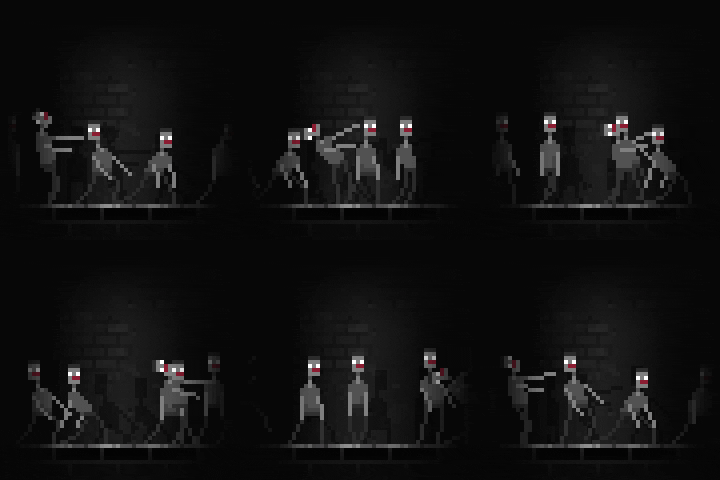
(Zombie Night Terror, alongside some amazing TIG forum GIF’s that seem to abound among indies)

1 Like

I remember researching into lighting/shadows for 2D sprites, and was absolutely stunned when I saw this guy’s work:

https://www.youtube.com/watch?v=-Q6ISVaM5Ww

And this guy’s use of Snow/Weather on 2D sprites too:

https://www.youtube.com/watch?v=vtYvNEmmHXE

I was interested in going in this direction, towards the end of the project.

Sorry if this is getting a bit off-topic, @GarBenjamin

1 Like

The trick is quite old, it was used by westwood in the cult blade runner adventure game (collector, it’s so rare and underrated).

The fun things is those “tricks” are infinitely more tailored to a programmer’s skillset, and we can cheat even further by having 3d objects set up and baked at runtime on 2d sprites, which my work great for background. A lot of animation (even humanoid) can be done through coding too (though this one is a bit more delicate for very expressively specific animation, but I haven’t gotten there yet). In fact I’m training a graphic artist right now to procedural generation of graphics, and one of the step is to generate a realistic walk cycle with only code.

There is a lot basic stuff that translate to code, which would only left the hard stuff to do or correct by hand. But even if it’s old, there is still a cultural resistance which mean people rediscover the technique every 5 years for some reason (it’s largely documented too, so there is no reason to ignore it).

1 Like