Because you put effort in your question and made a drawing, I put effort in giving a decent answer.
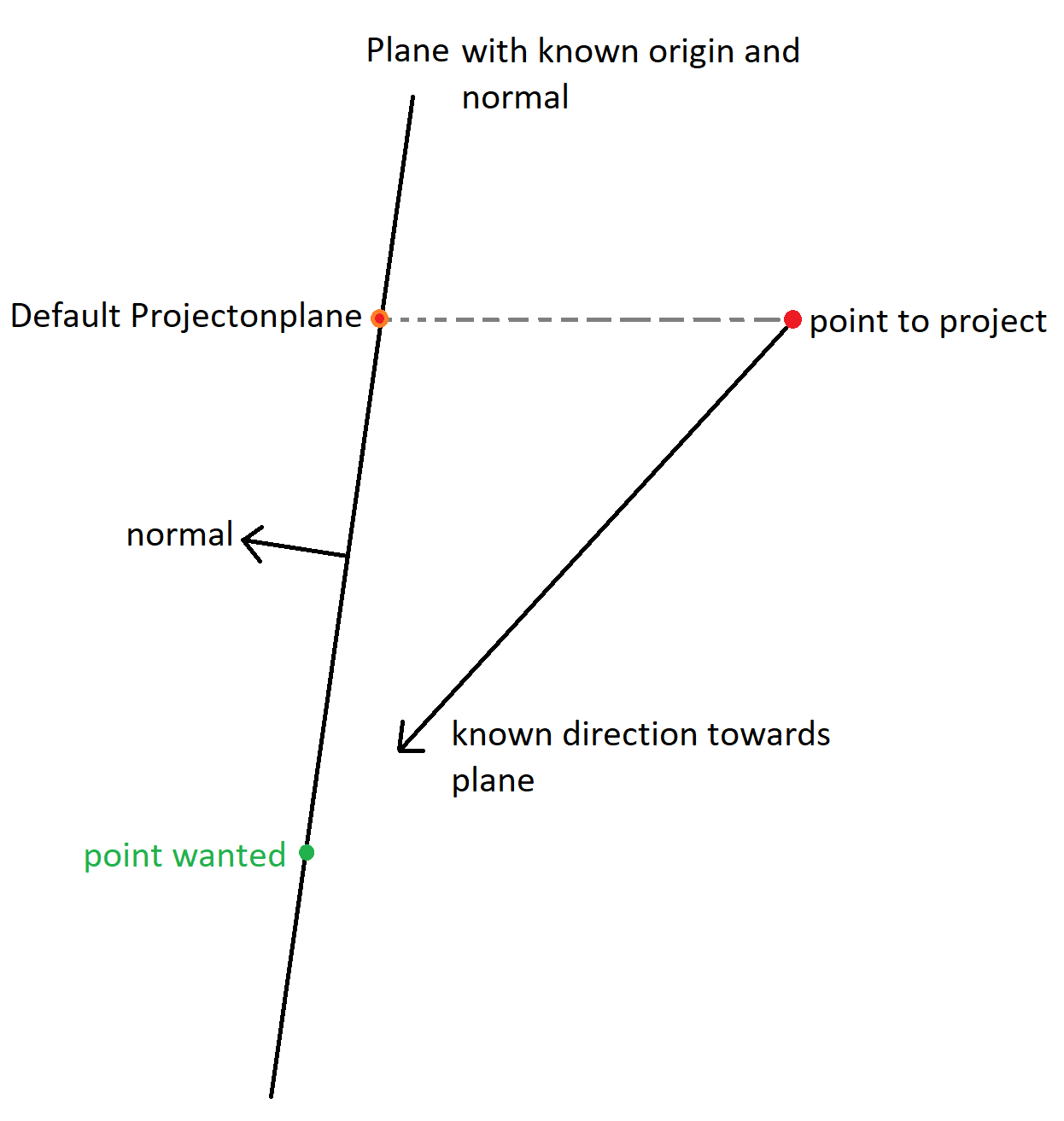
This problem converts to a math problem of finding the intersection of a plane (given by a point and a normal vector), and a line (given by a direction vector and a point).
• Let’s call the first point of the line (point to object) P1 (x1, y1, z1) and the second point P2 (x2, y2, z2). (P2 is another random point on the line, for example: P1 + direction vector towards plane).
• Let’s call the known point on the plane P3 (x3, y3, z3) and the normal vector N (nx, ny, nz).
• Let’s call the needed point P (x, y, z)
We can write the line equation in vector form as:
(P2-P1) . k + P1 (Where k is a random number)
1. We know that the needed point is on this line, for a certain value of k.
x = k.(x2 - x1) + x1
y = k.(y2 - y1) + y1
z = k.(z2 - z1) + z1
We also know that the vector (P3-P) must be perpendicular to the normal vector N. (Since (P3-P) is a vector of the plane)
2. For perpendicular vectors applies that their dot product equals zero:
(x3 - x).nx + (y3 - y).ny + (z3 - z)*nz = 0
Applying these 2 conditions, we get 4 equations with 4 variables: x, y, z and k.
When we solve these equations, we get:
x = ( ((y3 - y2).ny + (z3 - z2).nz + nx.x3).x1 - x2.((y3 - y1).ny + (z3 - z1).nz + nx.x3) ) / ( (x1 - x2).nx + (y1 - y2).ny + (z1 - z2).nz )

y = ( ((x3 - x2).nx + (z3 - z2).nz + ny.y3).y1 - y2.((x3 - x1).nx + (z3 - z1).nz + ny.y3) ) / ( (y1 - y2).ny + (x1 - x2).nx + (z1 - z2).nz )

z = ( ((y3 - y2).ny + (x3 - x2).nx + nz.z3).z1 - z2.((y3 - y1).ny + (x3 - x1).nx + nz.z3) ) / ( (z1 - z2).nz + (y1 - y2).ny + (x1 - x2).nx )

k = ( (x1 - x3).nx + (y1 - y3).ny + (z1 - z3).nz ) / ( (x1 - x2).nx + (y1 - y2).ny + (z1 - z2).nz )
You can either calculate x, y and z separately or calculate k and use it with the line equation.
I hope you understood somewhat what I tried to explain, best of luck!