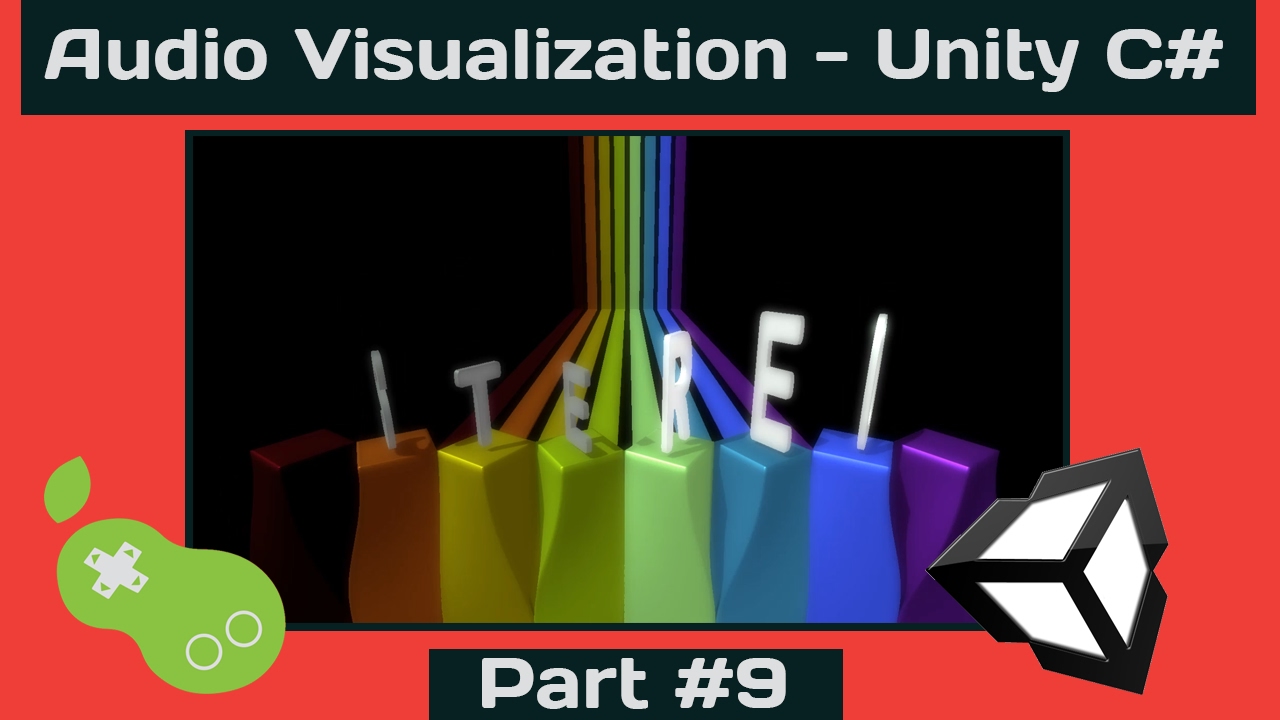
FFT Audio Visualization Video Tutorial

I have been working hard on creating an extensive video tutorial series on how to create your own Audio Visualizer in Unity C#.

Learn how to code your own music visualizer using c#.
In these series you will learn how to:

  • Use Fast Fourier Transform (FFT)
  • Visualize music into gameobjects
  • Scripting buffers for visualisation
  • Applying scripts to models, lights, transforms, camera, and shaders.

If you have any questions, or additions to this tutorial, feel free to reply. I’m hoping you will find this tutorial helpful.
I haven’t seen an extensive tutorial on this subject yet, so I decided to share my knowledge for free, so that you all may learn, and create more awesome stuff!
_Source files download: http://www.peerplay.nl/tutorials/peerplay-AudioVisTutPart1-source.zip_

Part 0 - Result

https://www.youtube.com/watch?v=5pmoP1ZOoNs

Part 1 - FFT/Spectrum Theory

https://www.youtube.com/watch?v=4Av788P9stk

Part 2 - GetSpectrumData in Unity

https://www.youtube.com/watch?v=0KqwmcQqg0s

Part 3 - Visualize 512 samples

https://www.youtube.com/watch?v=Ri1uNPNlaVs

Part 4 - Eight Frequency Bands

https://www.youtube.com/watch?v=mHk3ZiKNH48

Part 5 - Adding Buffers
https://www.youtube.com/watch?v=lEUuC3LQnzs (click link for video)

Part 6 - Ranged Usable Values
https://www.youtube.com/watch?v=QJCipD3YEE8 (click link for video)

Part 7 - Get Average Amplitude
https://www.youtube.com/watch?v=EAjNZJ8G0Hs (click link for video)

Part 8 - Audio Profile
https://www.youtube.com/watch?v=7ZpUVBpThBg (click link for video)

Part 9 - Stereo SpectrumData
https://www.youtube.com/watch?v=KqVsu07oAEM (click link for video)

Part 10 - 64 Audio Bands
https://www.youtube.com/watch?v=l77pAKrKe5s (click link for video)

7 Likes

Thank you for the series, really helpful for newbies like me :smile:

I am relatively new to Unity, my interest is not so much in creating games but in creating 3D Music Video Experiences that can be explored in virtual reality via the likes of the oculus rift.

so with regard to your audio viz tutorial above i would just like to say…

ThankYouThankYouThankYouThankYouThankYouThankYouThankYouThankYouThankYouThankYouThankYouThankYouThankYouThankYouThankYouThankYouThankYouThankYouThankYouThankYouThankYouThankYouThankYouThankYouThankYouThankYou!!!

and may i add…

ManyManyManyManyManyManyManyManyManyManyManyManyManyManyManyManyManyManyManyManyManyManyManyManyManyManyManyManyManyManyManyManyManyManyManyManyManyManyManyManyManyManyManyManyManyManyMany THANKS!

it is very much appreciated.

Could i just say, if you were ever to continue or expand on the audio viz tutorial, a couple of things I personally would really love to under stand how to do (of even if possible ) are listed below. All related to changing objects to music / input that i have found very difficult to even start to learn about on the ww etc. hopefully other audo viz fans would find useful too.


twisting / warping / distorting meshes for example walls flooring ceilings etc to music

changing the colour of an object depending for example on the amplitude of a piece of music spectrum… eg imagine a dark green cube that when a beat is sent to it, it grows very tall with the end that is moving up into the air getting brighter in colour / changes.. so for example when it is at its tallest, the part of the object fixed to the ground is still dark green, but as you travel up along the lengh of the object the colour gradually changes so that at the very top it is a bright glowing yellow. as the objects height collapses again it gradually returns to its original colour.

Additionally can the texture on the object graduially change along the length in a similar way too.. so for example when collapsed as a cube is looks say rusty n rough… but when fully extended the top end has gradually changed to a glassy semi transparent texture.

Its really all about shifting warping moving changing objects position shape colour and textures to music or other input.

:smiley:

AnyHoo,

regardless of the wish list,

ManyThanksManyThanksManyThanksManyThanksManyThanksManyThanksManyThanksManyThanksManyThanksManyThanksManyThanksManyThanksManyThanksManyThanksManyThanksManyThanksManyThanksManyThanksManyThanksManyThanksManyThanksManyThanksManyThanksManyThanksManyThanksManyThanksManyThanksManyThanksManyThanksManyThanksManyThanksManyThanksManyThanksManyThanksManyThanksManyThanksManyThanksManyThanks

for taking the time and trouble to do and share

Kinds Regards

Michael

I just uploaded a new part to the tutorial! Cheers!

More will follow, once I have more time :slight_smile:

Update: Another part added to the series!

1 Like

I just uploaded a new part of the tutorial! This time on Stereo Spectrumdata.

Thanks so much for making and sharing, great series!

I just uploaded part 10 of the Audio Visualization series! We are almost there though! This time about creating 64 audio bands. Enjoy!

For anyone who thought PeerPlay was finished, think again! :smile:

…and they just keep coming! Thanks PeerPlay, you rock!
\m/(>.<)\m/