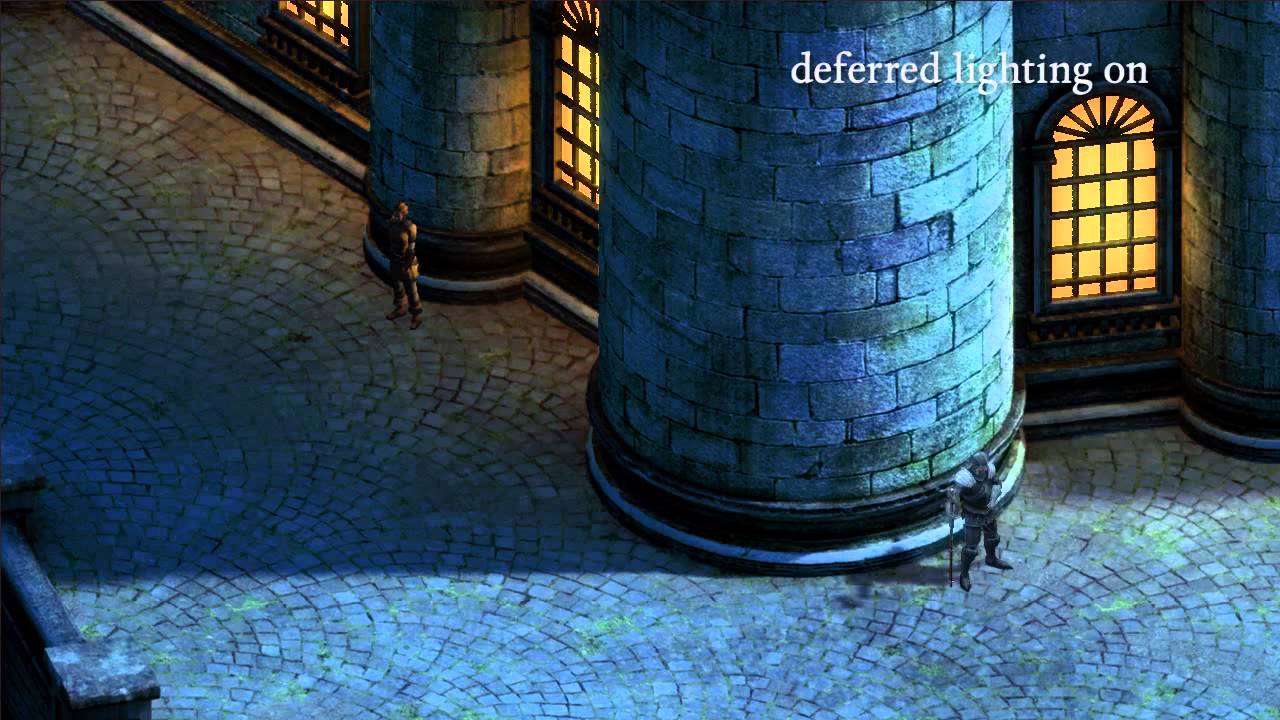
I’m currently checking out RPGs and researching how they’ve done their isometric artwork, Fallout 2 and so on worked out well enough, I know now that those old school RPGs use 2D artwork and then use grid movement a lot to dictate how their characters move.
However I’m checking out now how Tyranny and Pillars of Eternity are doing their art and character movement. It turns out that these games at least as far as Pillars of Eternity are concerned were definitely made with Unity itself so that’s great inspiration to draw on. However I’m curious as to how they do things like the buildings and the tents.
I can’t tell how they’ve done it all, it looks like it might actually be either purely 3D but then the artwork seems to sort of change depending on the objects that are being represented. So to give you an example in Tyranny at first glance you immediately see that bigger buildings and statues etc. almost look completely 3D, but when you zoom into things like tents you’ll see that they almost look painted.
Is it possible they’re using a mix of highly detailed sprites and 3D models? Then they’re just having the characters move past colliders for each? The reason I think it could be a mix is because of the art style, some of the structures look very smooth and 3D whilst the tents and crates look like they’re painted.
Bit of a complicated question I know, but I’m doing some heavy research with a campfire I’m looking at for example, the rocks and everything look like they’ve been done in photoshop and then they’ve put a fire particle effect on it.
Edit: Oh and yeah I’m just checking out some crates now and they’re in some shadow, it definitely looks like they’ve painted them in photoshop, how the hell have they managed that?
Pillars of eternity and tyranny use 3d models for characters.
In both games the backgrounds are quite obviously 2-dimensional.
Most likely scenario is that the scene is setup with orthographic cameras, and artwork is placed as sprites or something similar. You can freely mix sprites and 3d environments out of the box, unity will handle sort order for you.
That’s really interesting, thanks, I’m going to have to do some experimenting, I take it then the character movement is done on a terrain and navmesh? That’s one thing that’s been bugging me as well.
It’s actually kind of cool and complicated. The backgrounds are 2D, yeah, but their shaders use a lot of additional image data to control environmental interactions like the occlusion of one object by another, lights and shadows, reflections, and flows. While Obsidian were developing PoE, their development updates sometimes highlighted the different material layers in a scene (see here).
I’ve kind of worked it out, it really is pretty awesome, I’ll make up a detailed post once I’m sure of the steps, just got to experiment with some character movement but I think I have an idea of how to make it all work right.
You know what? I’m so pleased with myself about figuring this out I’m uploading the project I have because it’s easier than spending forever explaining it. I got the basic isometric gameplay working, it’s like @neginfinity said, you use an orthographic camera to achieve the 3D Isometric look with your art but what they’re doing then is clever as they’re using 3D gameobjects mixed in like a 3D plane to do all the character movement and so on.
Feel free to download the project and check it out, do some corrections if need be, the only extra thing I’d add after this is exactly what RPGs have where the mouse click movement stops working entirely if you mouse over it because if you click on an obstacle it causes the NavMeshAgent to freak out.
I’d have to do more experimenting, but I think I’ve gotten the right technique, I’ve even done a camera as well that you can move with WASD. What a weird way to develop games, but it is very interesting.
Grinding Gears (POE) did a presentation at Unite Melbourne a few years back. Their environment uses a single 2D texture. There is another 2D texture that contains depth data, which is used in the shader to render things infront or behind characters. Other textures are used to hold collision data and so on.
This approach let’s the artists basically focus on making as impressive a 2D environment as possible. They don’t have to worry about 3D elements during art creation.
It’s also computationally much cheaper at runtime then a full set of 3D models.
Although not the games you mentioned I thought this might be relevant/interesting.
The Brotherhood (Stasis, Cayne, Beautiful Desolation) use a (somewhat) similar technique.

 with a campfire I’m looking at for example, the rocks and everything look like they’ve been done in photoshop and then they’ve put a fire particle effect on it.