I thought it would be helpful to start a thread for those of you who are new to using Skinned Cloth within Unity. With the limited documentation and lack of tutorials online, I thought a thread in which we all can contribute with suggestions, tips and tricks would be beneficial.
I created a character mesh in which I wanted to simulate a semi skin-tight dress, and see how subtle motion would enhance the feel of the outfit. I feel it’s import to start out by understanding what it can and can’t do, based on my experience with it.
You can’t have an animated character, model some clothes for it, and expect the cloth to react to the character mesh. Maybe in 5 years we’ll have that in real-time, but not today! Lets say you have a walk cycle animation for your character. You’ll also need a “walk cycle animation” for your clothing as well. It’s not automatically going to conform to your character mesh. Mega-Fiers should have vertex morphing for skinned models soon, so I hope that will help alleviate having to create all the animations for our characters clothing. Will that work with Skinned Cloth? I have no idea…
You can’t use any custom colliders. So clipping into your character will happen; such as a flowing skirt into it’s legs and long hair into its shoulders and back, etc. You’ll need to use bones/weighting to keep that from happening, and use Skinned Cloth to “enhance” the feel of cloth motion. Any part of the clothing that you’d like to see a lot of movement in, such as flowing skirts for example, you’ll need to keep those polygons a significant distance from the character to avoid clipping.
In order to see your Skinned Cloth react, you’ll need to set up some script to have your character rotate, or play an animation. This seems pretty obvious, but I thought I would throw it out there. Cloth doesn’t move without an external force, aside from gravity on/off within the Skinned Cloth panel and the cube weighting info.
Think of cloth as something elastic. The more you want it to flow with your characters movements, the more stretching between vertices will happen. One thought is to design extra edge loops where you would like the extra movement, like for the bottom of a skirt for example. Also based on your Bending Stiffness and Stretching Stiffness, this will “shrink” or compress your vertices, so you might want to keep that in mind when designing your clothing.
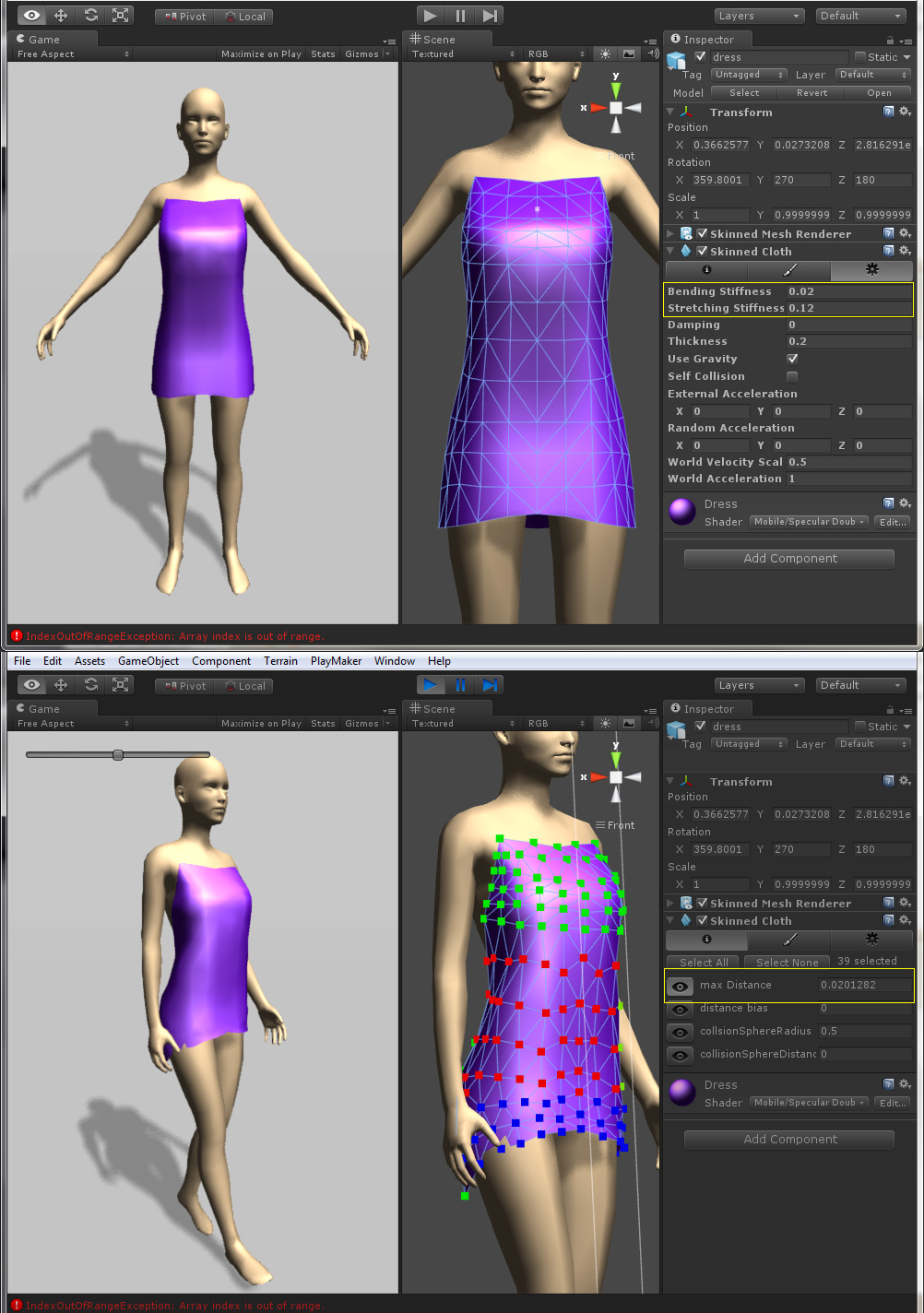
In my example below, it was easier for me to adjust the cloth settings starting from the greatest cloth movement to no movement, working backward. That way I can test how much movement I would want in the skirt, which in my example would have the most cloth movement, and then work up the cloth mesh in which there will be no movement at the top of the dress. Another tip is that any skin tight clothing; like around my character hips, butt and chest, I put a value of 0 since I don’t want any clipping to occur. Plus there really shouldn’t be any cloth movement there anyways, since it is skin tight. The cloth I was trying to simulate was something light and flowing like silk.
The yellow boxes were the only parameters I felt made any sort of difference. The green cubes had a value of 0 in the Max Distance, the red (the cubes selected) had a .02 since I wanted some slight motion in the stomach area, and the blue had a .08 for a more flowing skirt motion. They need some tweaking, both in my skinning and in the Skinned Cloth panels, but it was a good start and the Skinned Cloth gave nice dynamic motion for some visual interest.
And don’t ask me why there are black cubes that you can’t select, that’s a mystery to me. And I did have a couple of problem areas, such as that lower left green cube behaving with it’s own agenda… A bug perhaps?
Anyways I’m new to Skinned Cloth, so this is my 2-cents for playing around with it one evening. Please feel free to leave questions, comments, and/or suggestions/tips for everyone to benefit from!

 I’m curious how its features and performance compare to the built-in Unity interactive cloth and skinned cloth.